Studies on Socialism with Chinese Characteristics ›› 2025, Vol. 7 ›› Issue (6): 53-69.

Previous Articles     Next Articles

The Different Manifestations, Formation Mechanisms, and Resolution Paths of "Involutionary" Competition: An Analysis Based on Marxist Political Economy

Yang Mingxuan, Sui Jigang   

  • Received:2025-10-26 Online:2025-12-28 Published:2026-01-28

Abstract:

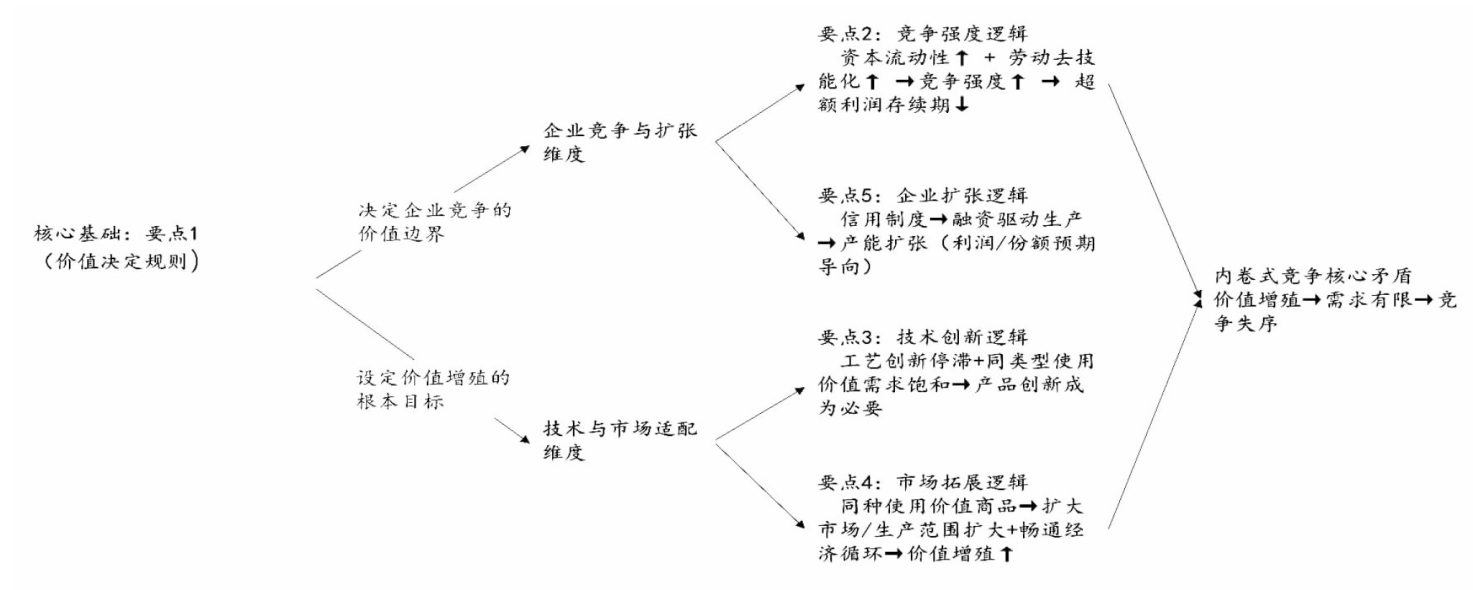
"Involutionary" competition is characterized by low prices and low quality, often accompanied by low profit margins and overcapacity. This is fundamentally incompatible with the goals proposed at the 4th Plenary Session of the 20th Central Committee of the Communist Party of China, namely "achieving remarkable results in high-quality development and significantly enhancing the level of self-reliance and self-improvement in science and technology". From the perspective of Marxist political economy, "involutionary" competition reflects the structural contradiction of capital accumulation, i.e., the contradiction between value production and value realization. On one hand, increased capital mobility and the accelerated process of deskilling have lowered industry entry barriers, intensifying both intra-sectoral and inter-sectoral competition. On the other hand, amid technological progress—which reduces the value of per unit commodity—the growth of demand scale and process innovation have entered a stage of marginal decline, creating an output-accumulation bottleneck. To break the involutional competition, efforts on both the supply and demand sides are required while optimizing institutional supply. On the supply side, alleviating the price competition of homogeneous products caused by the approaching limit of process innovation requires product innovation and the creation of new sectors. Institutionally, hedging against involutionary competition necessarily involves smoothing economic circulation, establishing a unified national market, and actively expanding the international market. On the demand side, we should foster new consumption growth drivers and sustainable consumption momentum through supply-demand coordination, and realize the goal of "guiding new supply with new demand and creating new demand with new supply."

Key words: involutionary competition, capital accumulation, product innovation, process innovation

CLC Number: