Studies on Socialism with Chinese Characteristics ›› 2025, Vol. 7 ›› Issue (6): 90-102.doi: 10.13858/j.cnki.cn32-1312/c.20251126.003

Previous Articles     Next Articles

Digital Innovation in Rural Elder Care Service Provision at the County Level: Practical Exploration and Optimization Paths

Wei Yan, Li Jing   

  • Received:2025-11-15 Online:2025-12-28 Published:2026-01-28

Abstract:

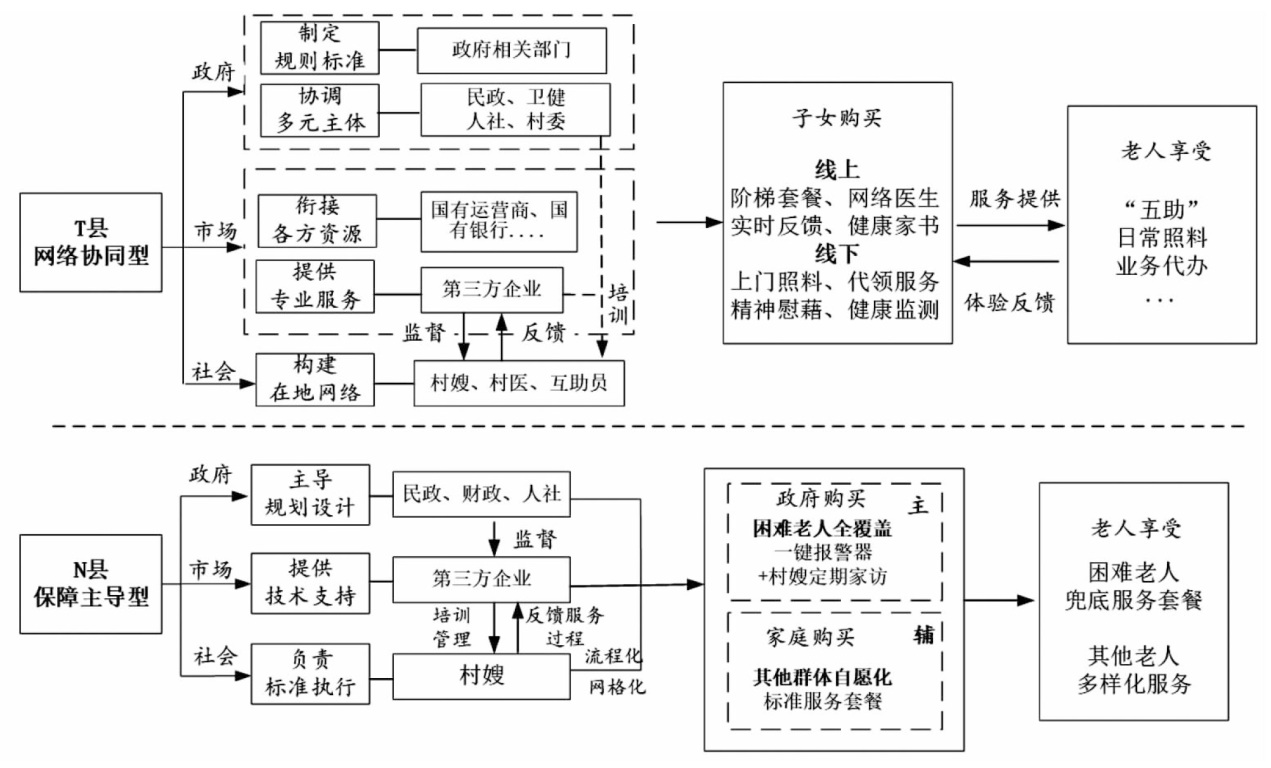
Enhancing the digital provision of elderly care services in rural areas is key to linking proactive measures to address the aging population with the rural revitalization strategy. However, current practices face setbacks because digital technologies are often detached from local culture, lack adequate infrastructure, and the absence of a technology translation role, leading to poor adaptation with local governance and inefficient service delivery. Drawing on embeddedness theory, this study analyzes two distinct innovative models: the "market-driven + Local Community Helpers Linkage" model in less-developed T County, Guizhou, and the "Government-led + Local Community Helpers Implementation" model in more-developed N County, Anhui. This study proposes a five-dimensional embeddedness framework and explains its internal mechanism, which involves multi-stakeholder collaboration and minimalist tool adaptation, for overcoming digital transformation challenges. Strategically, this study emphasizes building differentiated digital service models based on county-level endowments. Policy recommendations from this study include "investing in people" to empower local human capital, promoting the deep integration of technology with local culture, establishing a multi-collaborative governance structure, and perfecting sustainable, incentive-compatible institutions. This study offers guidance for establishing a high-quality, sustainable rural digital elderly care system.

Key words: rural elderly care, elderly care service supply, embeddedness theory

CLC Number: