中国特色社会主义研究 ›› 2025, Issue (6): 90-102.doi: 10.13858/j.cnki.cn32-1312/c.20251126.003

• 中国式现代化理论与实践 • 上一篇    下一篇

县域农村养老服务供给数字化创新的实践探索与优化路径

韦艳, 李婧   

  • 收稿日期:2025-11-15 出版日期:2025-12-28 发布日期:2026-01-28
  • 作者简介:韦艳,西安财经大学统计与数据科学学院教授|李婧,西北大学公共管理学院博士研究生
  • 基金资助:
    国家社科基金重大项目“人口动态演进下西部县域家庭的结构变迁与功能可持续发展研究”(24&ZD153);国家社科基金项目“数字乡村建设对农村智慧养老服务体系的影响及优化路径研究”(23BRK011)

Digital Innovation in Rural Elder Care Service Provision at the County Level: Practical Exploration and Optimization Paths

Wei Yan, Li Jing   

  • Received:2025-11-15 Online:2025-12-28 Published:2026-01-28

摘要:

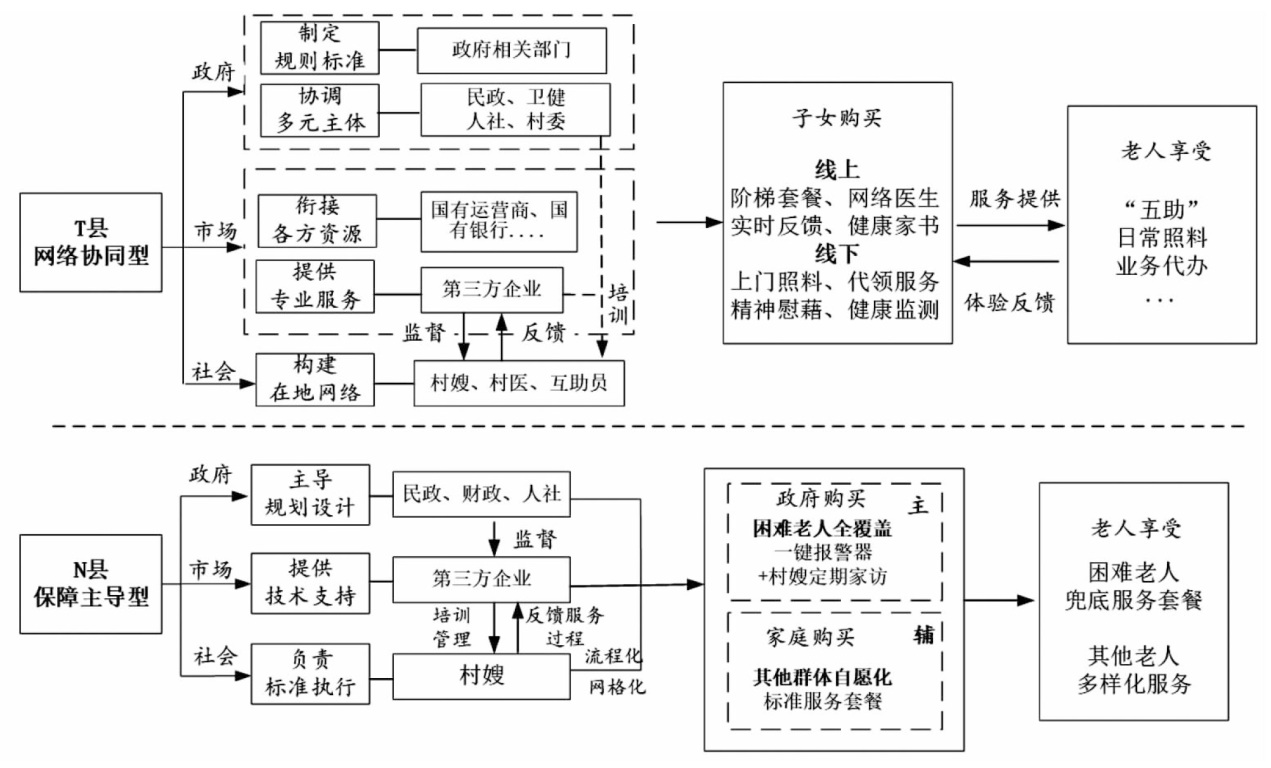
提升农村养老服务供给数字化水平是衔接积极应对人口老龄化与乡村振兴战略的关键。然而,现有实践中,数字技术常因脱离乡土认知、基建适配不足、技术转译角色缺失,导致其与地方实际、市场运行及养老需求无法适配,最终造成服务形式单一、资源流动效率较低的困境。立足嵌入理论视角,以欠发达地区贵州省T县“市场驱动+村嫂联结”与较发达地区安徽省N县“政府保障+村嫂执行”两种养老服务创新实践为案例,提炼出文化、关系、技术、结构、制度的五维嵌入分析框架,并系统阐释其通过价值符号联结重塑服务认同、多元主体协同整合服务资源、极简工具适配降低使用门槛、治理体系整合畅通服务链路、长效规则保障稳定服务供给,进而破解数字化转型困境的内在机理。基于此,提出优化方向:战略层面应立足县域资源禀赋,构建差异化的农村数字化养老服务提供方案;政策层面需坚持“投资于人”导向激活本土人力资本,推动数字技术与乡土文化深度融合,构建多元协同的服务治理格局,并完善激励相容的制度保障体系。研究结论可为构建高质量、可持续的农村数字化养老服务体系提供理论参考与实践指引。

关键词: 农村养老, 养老服务供给, 嵌入理论

Abstract:

Enhancing the digital provision of elderly care services in rural areas is key to linking proactive measures to address the aging population with the rural revitalization strategy. However, current practices face setbacks because digital technologies are often detached from local culture, lack adequate infrastructure, and the absence of a technology translation role, leading to poor adaptation with local governance and inefficient service delivery. Drawing on embeddedness theory, this study analyzes two distinct innovative models: the "market-driven + Local Community Helpers Linkage" model in less-developed T County, Guizhou, and the "Government-led + Local Community Helpers Implementation" model in more-developed N County, Anhui. This study proposes a five-dimensional embeddedness framework and explains its internal mechanism, which involves multi-stakeholder collaboration and minimalist tool adaptation, for overcoming digital transformation challenges. Strategically, this study emphasizes building differentiated digital service models based on county-level endowments. Policy recommendations from this study include "investing in people" to empower local human capital, promoting the deep integration of technology with local culture, establishing a multi-collaborative governance structure, and perfecting sustainable, incentive-compatible institutions. This study offers guidance for establishing a high-quality, sustainable rural digital elderly care system.

Key words: rural elderly care, elderly care service supply, embeddedness theory

中图分类号: